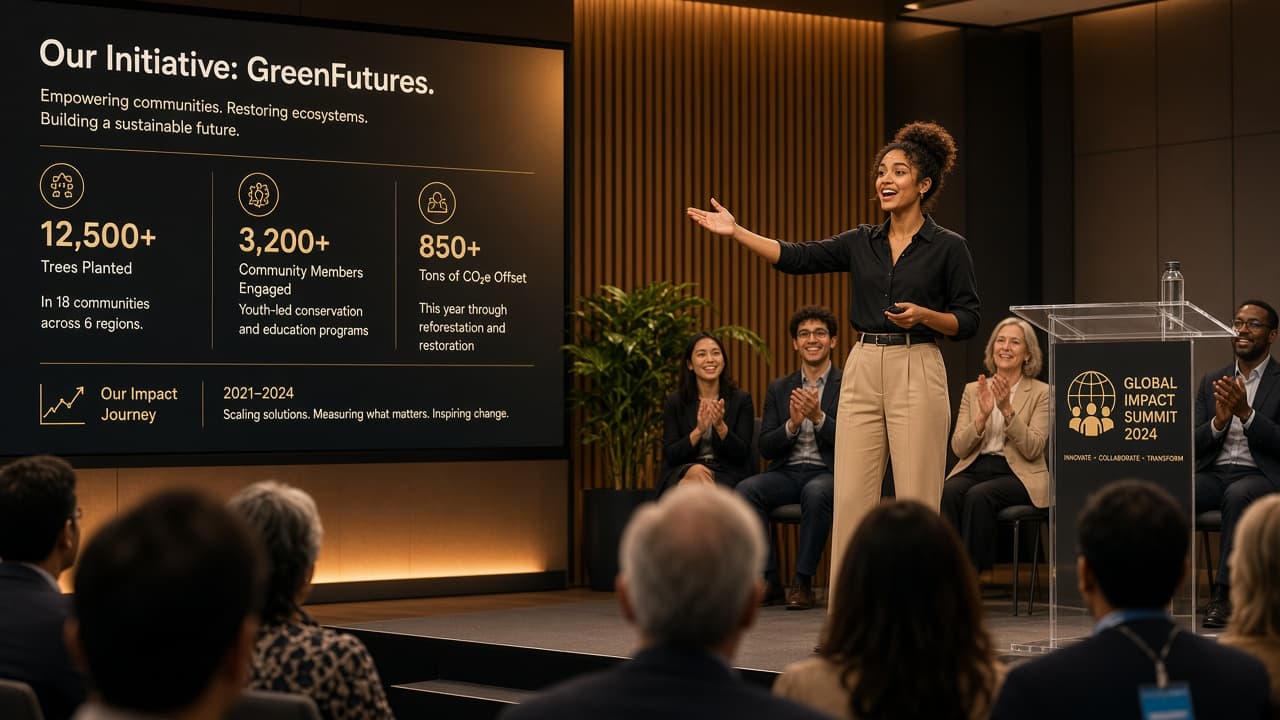
Every year, thousands of passionate young innovators and community builders from more than 100 countries enter the Opportunity Desk Impact Challenge (ODIC). Many lead remarkable grassroots projects, yet only a select few advance to the Top 12 finalists, secure seed funding, and earn international recognition. The deciding factor is rarely who works the longest hours — it is who articulates their story with measurable clarity, strategic rigor, and credible momentum.
The ODIC evaluation committee does not evaluate unlaunched concepts or abstract promises. They look for proven grassroots champions who have demonstrated resilience, built community trust, and generated verifiable outcomes with limited resources. Whether you are running a literacy workshop, a rural climate initiative, or a community health clinic, this comprehensive applicant playbook reveals how to position your initiative to stand out and win in 2026.
Quick Matrix — Pillars of a Winning ODIC Application
| Application Pillar | What the Judges Look For | Fatal Mistakes to Avoid |
|---|---|---|
| 1. Track Record & Metrics | Clear distinction between activities (outputs) and sustained community outcomes; verified beneficiary numbers over 12–24 months. | Vague statements such as "we empowered hundreds of youth" without dates, locations, or measurable skill milestones. |
| 2. Platform Connection | Authentic stories showing how access to global opportunities (like OD) accelerated your journey and how you cascade opportunities down to others. | Treating the ecosystem question as a copy-paste afterthought or failing to show how you multiply knowledge locally. |
| 3. 60-Second Video Pitch | Disciplined visual storytelling: 10s problem hook, 30s field evidence over b-roll, 20s catalytic ask; crisp subtitles and clear audio. | Talking into a shaky phone in a noisy room with no subtitles, running overtime, or spending 45 seconds on personal pleasantries. |
| 4. Financial Sustainability | Clear business/operational model, local partnerships, community co-ownership, and resilience beyond donor grant reliance. | Relying 100% on continuous external charity with no plan for earned revenue or community-supported operations. |
| 5. Mobilization Campaign | Pre-organized voting strategy: targeted WhatsApp groups, alumni networks, and framing the vote as a shared communal milestone. | Waiting until public voting opens before telling your community, leading to low digital engagement and zero momentum. |
1. Audit Your Track Record and Quantify Your Story
Judges review hundreds of generic applications claiming an applicant is "deeply passionate about transforming their community." Passion is the baseline requirement. Empirical proof of execution is what earns a spot in the finalist circle.
Before writing a single word in the application portal, conduct a thorough audit of your initiative’s milestones over the past twelve to twenty-four months:
- Differentiate Outputs from Outcomes: An output is "we hosted 4 digital literacy workshops for 120 girls." An outcome is "92 of those girls passed certified exams, and 28 secured remote freelancing gigs or internships within 6 months."
- Map Your Geographic & Demographic Reach: State exact community names, local government areas, or schools served. Specificity proves authentic grassroots presence.
- Consolidate Verifiable Artifacts: Organize high-resolution field photographs, written beneficiary testimonials, local government permissions, and third-party news features in a shared cloud folder so every claim you make can be backed up immediately.
2. Clarify Your Authentic Connection to the Global Opportunity Ecosystem
A distinctive dimension of the Opportunity Desk Impact Challenge is recognizing changemakers who embody the values of the global access movement. The evaluators prioritize applicants who have actively grown through the platform, accessed fellowships, seed grants, or exchange programs, and are actively paying that access forward.
When drafting your submission:
- Cite Concrete Milestones: Identify the specific fellowships, webinars, accelerator programs, or international calls you discovered through Opportunity Desk that shaped your trajectory.
- Demonstrate the Multiplier Effect: Explain how gaining that knowledge transformed your capacity to serve others. Did you train 50 other youth to win scholarships? Did you establish a community learning hub? Show that investing in you directly impacts hundreds of others.
- Be Genuine: Avoid flattering platitudes. Focus on real inflection points where timely access to information bridged an otherwise insurmountable barrier.
3. Master the 60-Second Video Pitch (The Deciding Factor)
The 60-second video is the most critical screening element of your application. Judges watch dozens of clips in a single sitting. If your opening is sluggish or your audio is muffled, your application risks being passed over. Approach your video with film-director discipline.
Second-by-Second Video Pitch Breakdown
| Timestamp | Segment Focus | Visual & Delivery Strategy |
|---|---|---|
| 0:00 – 0:10 (10 secs) | The Hook & Problem | State your name, country, and the acute community problem you tackle. Jump straight into the urgent challenge with zero fluff. |
| 0:11 – 0:40 (30 secs) | Action & Evidence | Voiceover your proven results while cutting directly to live b-roll footage of you working in the field with beneficiaries, trainees, or community members. |
| 0:41 – 1:00 (20 secs) | The Catalyst & Vision | Explain exactly how winning ODIC funding and mentorship will unlock your next major operational milestone. Close with energy and a smile. |
Technical Production Rules for the Video
- Orientation: Record horizontally (16:9 landscape mode). Vertical selfie videos look unprofessional on judging panels.
- Audio Quality: Audio is more important than video resolution. Use an affordable wired lapel microphone or record in an echo-free room. Wind noise or room echo will ruin your submission.
- Subtitles: Always hardcode or burn English subtitles into the video (using free tools like CapCut or Premiere). Many judges review submissions with muted or low audio, and accents vary widely across continents.
- Lighting: Face a natural window or a soft light source. Never record with a bright window behind you.
4. Articulate Scalability Beyond Grant Dependency
A fatal flaw in many social sector applications is proposing an initiative that completely collapses the moment grant capital runs dry. Selection panels look for visionary builders who design for sustainability.
Demonstrate operational resilience by highlighting:
- Community Co-Ownership: Are local community elders, schools, or youth volunteers trained to deliver activities independently? When communities own the project, maintenance costs plunge.
- Earned-Income Mechanisms: Even modest earned revenue — such as nominal workshop fees, product sales from agricultural outputs, or fee-for-service consulting — proves market demand and operational viability.
- Precision Budgeting for Prize Capital: If you receive the $500 top cash prize, do not say "we will use it for general expansion." Detail precisely what will be purchased: "The $500 prize will fund 2 solar-powered water filtration units and 60 testing kits, extending daily clean water access to 450 additional households."
5. Build Your Mobilization Campaign in Advance (Voting Phase)
Reaching the Top 12 finalist stage transitions the challenge into a dual-scoring format: panel jury evaluation combined with public voting. Applicants who wait until voting opens to tell their supporters almost always struggle.
Prepare your digital mobilization strategy early:
- Prime Your Networks Early: Keep your alumni groups, faith networks, volunteer teams, and university peers updated on your progress months before announcements.
- Prepare Ready-to-Share Assets: Design clean visual flyers and draft one-click WhatsApp broadcast messages with the direct voting link so your supporters can share it with zero friction.
- Frame the Vote Communally: Frame your campaign not as personal validation, but as a victory for the community and beneficiaries you represent. People eagerly rally behind causes that elevate an entire community.
Overview — Opportunity Desk Impact Challenge (ODIC) 2026 Details
| Feature | Details |
|---|---|
| Target Applicants | Grassroots changemakers, founders, project leads, and social entrepreneurs |
| Eligible Age Range | 18 to 30 years old |
| Nationality / Region | Open to all nationalities and countries worldwide |
| Impact Requirement | Minimum 1 year of documented, verifiable community impact |
| Application Fee | 100% Free to apply |
| Core Prizes | $1,000 shared cash prize pool ($500 for 1st, $300 for 2nd, $200 for 3rd), certificates of recognition |
| Fellowship & Grants | Automatic admission into Savvy Fellowship; 12 fully funded spots in Global Changemakers Project Management course ($150 value) with eligibility for Seed Grants |
| Mentorship & Spotlight | 1-on-1 mentorship sessions with Savvy founder Chidi Nwaogu; exclusive OD Young Person of the Month features; Ideation Hub Africa access |
| Special Honors | Top 30 Under 30 Changemakers global listing and feature profile |
Frequently Asked Questions (FAQs)
Do I need to be a legally registered NGO or company to apply?
No. The OD Impact Challenge celebrates authentic grassroots work. You can apply as an individual founder, a community organizer, an unregistered youth group, or a social venture leader, provided you have at least one year of verifiable community impact.
Can I apply if English is not my native language?
Yes. The competition is open to changemakers worldwide. You may record your 60-second video in your native language, provided you include clear, synchronized English subtitles.
What counts as a "one-year track record"?
Your project or initiative must have been active on the ground for at least 12 months prior to applying. The judges look for consistency, sustained engagement, and measurable outcomes rather than short-lived pilot events.
Can co-founders or teams apply together?
Yes, team initiatives are encouraged. However, you must designate one lead applicant between 18 and 30 years old who will submit the application form, record the video pitch, and represent the team throughout the competition.
When does the OD Impact Challenge 2026 application portal open?
Following the early preparation announcement, the official application window, specific deadlines, and submission forms are published on the official Opportunity Desk portal and newsletter. Use this preparation period to audit your metrics, film your footage, and organize your supporting documents.
Explore More Opportunities on Opportunity Station
- Browse Latest Grants & Fellowships
- Browse All Application & Leadership Guides
- Finding the Right Investors for Your Business
- Leadership Empowerment: Unlocking Your Potential to Lead with Impact
Editorial Note: Based on the applicant playbook guidelines authored by Favour Abatang for the Opportunity Desk Impact Challenge; structured, adapted, and expanded with actionable frameworks by the Opportunity Station Editorial Team.