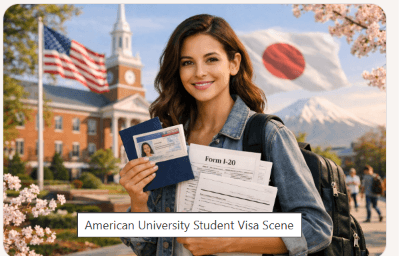
Studying in the United States is a dream for millions of students around the world. Home to many of the world's top universities, the U.S. offers high-quality education, research opportunities, and a multicultural learning environment.
If you have received admission from a U.S. college or university, the next important step is applying for an F-1 Student Visa. While the process may seem complicated at first, it becomes much easier when you understand each step.
This guide explains the complete F-1 student visa process in simple language, helping you prepare your application with confidence. For broader planning, see our complete visa guidance and tips on how to get a fully funded scholarship to help finance your studies.
What Is an F-1 Student Visa?
The F-1 Visa is a non-immigrant visa that allows international students to study full-time at an accredited educational institution in the United States.
You can apply for an F-1 visa after receiving admission from a Student and Exchange Visitor Program (SEVP)-approved school. Official information is available from the U.S. Department of State — Student Visas (F-1) and EducationUSA.
Who Can Apply for an F-1 Visa?
You may qualify for an F-1 visa if you:
- Have been accepted by an approved U.S. educational institution.
- Intend to study full-time.
- Have enough financial resources to cover your education and living expenses.
- Hold a valid passport.
- Plan to return to your home country after completing your studies.
Meeting these basic requirements is the first step toward a successful application.
Step 1: Receive Admission from a U.S. Institution
Before applying for a visa, you must first secure admission to a U.S. university, college, language school, or other SEVP-certified institution.
Once admitted, your school will issue an important document called the Form I-20 (Certificate of Eligibility for Nonimmigrant Student Status).
Review the information on your Form I-20 carefully and keep it safe, as you will need it throughout the visa process.
Step 2: Pay the SEVIS Fee
After receiving your Form I-20, you must pay the SEVIS I-901 Fee.
This fee supports the Student and Exchange Visitor Information System (SEVIS), which tracks international students during their studies. Pay and confirm your receipt through the official SEVIS I-901 Fee portal (FMJfee.com).
After payment, download and print your payment confirmation receipt.
Step 3: Complete the DS-160 Application
The next step is filling out the online DS-160 Nonimmigrant Visa Application.
During this application, you will provide:
- Personal information
- Passport details
- Educational background
- Travel plans
- Security questions
Answer every question honestly and carefully. After submitting the form, save the confirmation page with the barcode.
Step 4: Pay the Visa Application Fee
The U.S. visa application requires a non-refundable visa fee.
Payment methods vary by country, so check the instructions provided by your local U.S. Embassy or Consulate.
Keep your payment receipt because you may need it when scheduling your interview.
Step 5: Schedule Your Visa Interview
Most applicants between the ages of 14 and 79 are required to attend a visa interview.
Book your appointment as early as possible because interview dates may fill quickly, especially before university semesters begin.
Step 6: Prepare Your Required Documents
Having organized documents makes your interview much smoother.
Common documents include:
- Valid passport
- Form I-20
- DS-160 confirmation page
- Visa appointment confirmation
- SEVIS fee receipt
- Visa fee payment receipt
- Passport-size photographs (if required)
- University admission letter
- Academic transcripts and certificates
- Standardized test scores (if applicable)
- Financial documents
- Bank statements
- Scholarship or sponsorship letters
Carry both original documents and photocopies whenever possible.
Step 7: Attend the Visa Interview
The visa interview is one of the most important parts of your application.
The officer may ask questions such as:
- Why did you choose this university?
- Why do you want to study in the United States?
- Who will pay for your education?
- What are your future career plans?
- Do you plan to return to your home country after graduation?
Answer confidently, honestly, and clearly. Do not memorize scripted answers. Speak naturally and explain your genuine plans. Building communication skills through resources like our leadership empowerment guide can help you present yourself with confidence.
Step 8: Wait for the Visa Decision
After the interview, your application may be:
- Approved
- Refused
- Placed under administrative processing
- Requested for additional documents
Processing times vary depending on your country and individual circumstances.
Common Reasons for F-1 Visa Refusal
Many students worry about visa rejection. In many cases, refusals happen because applicants fail to provide enough supporting information.
Some common reasons include:
- Weak financial evidence.
- Incomplete documentation.
- Inconsistent answers during the interview.
- Failure to demonstrate strong ties to the home country.
- Providing false or misleading information.
Preparing carefully can significantly improve your chances of approval.
Tips for a Successful F-1 Visa Interview
These practical tips can help you perform well during your interview:
- Arrive early at the embassy or consulate.
- Dress neatly and professionally.
- Speak honestly and confidently.
- Answer only the question asked.
- Carry organized documents.
- Know basic information about your university and program.
- Explain your future career goals clearly.
- Stay calm throughout the interview.
Confidence comes from preparation. Strong application essays and statements also matter—see our guides on writing a winning scholarship essay and crafting a strong statement of purpose.
Can You Work on an F-1 Visa?
Yes, but there are important rules.
International students may be allowed to:
- Work on campus during their studies.
- Participate in Curricular Practical Training (CPT).
- Apply for Optional Practical Training (OPT) after meeting eligibility requirements.
Always follow U.S. immigration regulations before accepting any employment. Review current rules on Study in the States and USCIS.
Frequently Asked Questions
How early can I apply for an F-1 visa?
You can generally apply after receiving your Form I-20 and paying the required SEVIS fee. It is recommended to begin the process several months before your course starts.
Is an interview mandatory?
Most applicants between the ages of 14 and 79 are required to attend a visa interview.
How long does F-1 visa processing take?
Processing times vary depending on your country and the workload of the U.S. Embassy or Consulate.
Can I travel before my classes begin?
Students are generally allowed to enter the United States up to 30 days before the program start date listed on the Form I-20.
Can my family travel with me?
Eligible spouses and unmarried children under 21 may apply for an F-2 dependent visa if they meet the necessary requirements.
Final Thoughts
The F-1 student visa is an important step toward studying in the United States. Although the application process involves several stages, careful preparation can make the experience much easier.
Organize your documents, understand your study plans, prepare for your interview, and always provide honest information. Following the official instructions and applying early will help you avoid unnecessary delays.
For a detailed 2026-focused walkthrough with additional official links, you may also read our US F-1 Student Visa 2026 guide.
A successful visa application brings you one step closer to achieving your academic goals and gaining valuable international experience.